
Beehive panels: the gallery that buzzed
Slovenians are the only nation that hung its painting gallery in front of the bees. This is the story of the little boards that inspired our folk deck.
What is a beehive panel, anyway?
A beehive panel is the painted front board of a wooden hive, the kranjič. On a few dozen centimetres of wood, folk painters set saints and Bible scenes, but also everyday joy and mockery: the hunter's funeral carried by the animals; the devil sharpening a gossip's tongue; the tailor duelling a snail. Sacred and mischievous, side by side on the same bee-house.
The oldest surviving panels reach back to the mid-eighteenth century, and they flourished through the nineteenth, above all in Upper Carniola and Carinthia. Thousands were painted: an entire folk gallery in the open air.
What were they for?
By the homespun explanation, the bright pictures helped the bees (and the beekeeper) tell hive from hive. But above all the panels were pride: proof that this house kept order, faith and humour. When newer hives began replacing the kranjič at the end of the nineteenth century, the painting slowly died away, and the little boards wandered into museums and private collections, where we admire them still.
From boards to cards
When we designed the folk deck for Tarok 124, we asked ourselves: what would tarok look like if a master of beehive panels had painted it? The answer is cards framed in red and green, carnations and daisies along the edges, bees and a skep on the back, and Zlatorog on trump XXI, the white chamois with golden horns from the Triglav legend that Rudolf Baumbach set in verse.
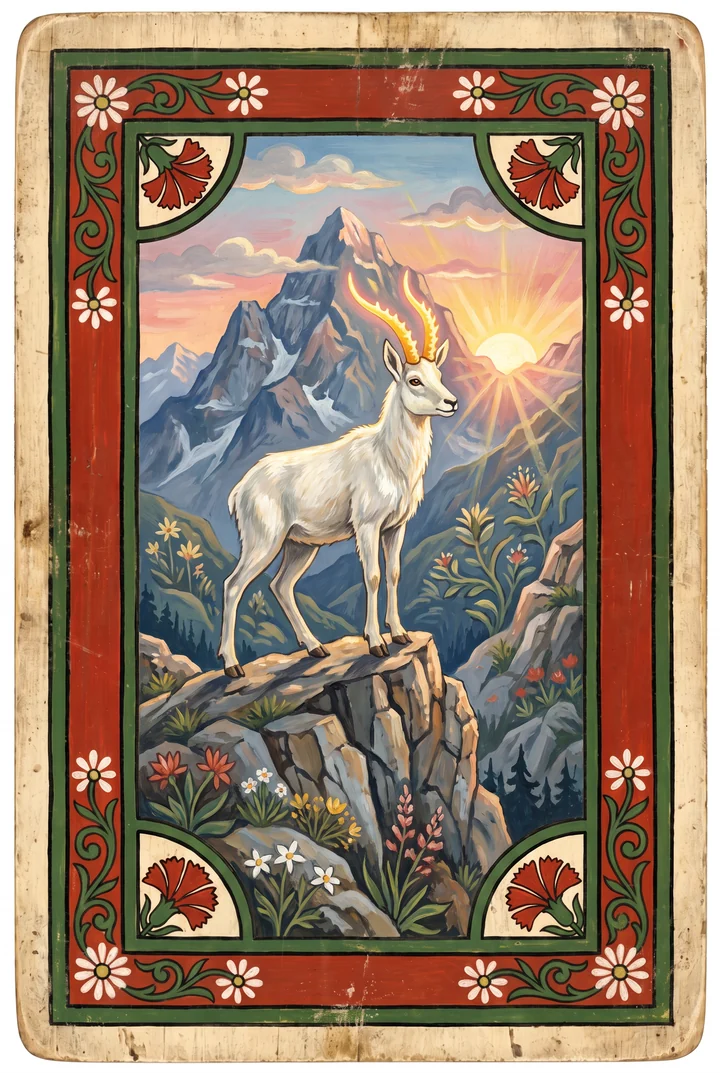
Every card of the folk deck honours that heritage: not a copy but a continuation, the same hand that once adorned bee-houses, now shuffled into a deck. See the whole deck in the card gallery.
Where to see them in person
The largest collections are kept by the Slovene Ethnographic Museum in Ljubljana and the Museum of Apiculture in Radovljica. Worth the trip, and then home for a game of klop.
Sources & reading
- Slovenski etnografski muzej: the beehive-panel collection
- Čebelarski muzej Radovljica, stalna razstava o kranjiču in končnicah
- Wikipedia: Beehive panel and Zlatorog entries
The folk deck awaits
Play with Zlatorog.
The first game is on the house: no sign-up.
✦ click a card to flip it ✦